Sunday, August 6, 2017

Susan Seddon-Boulet \ At the beginning of time ...


These pictures as the door to the artist's world.
In the world of fairy tales, mysticism, mythology, shamanism and fantasy.
For me they come from the epics of the ancient Indians.
And most importantly! They can be read as a book!
On this occasion, I read the myths of the Indians.
Also has reflected, and has laughed.))
But I really liked one of the wisdoms. It's forever!
"The sun can shine to you, or it may not shine.
It all depends on whether you turn to him face. "


At the beginning of time the land was barren, and men did not grow a beard.
Only later did the trees begin to appear.
At the beginning of time, the foam was black.
At the beginning of time, there was no food, no medicine.
In the beginning of time people were with tails.


Listen to the way the trees sing - the wind plays softly on the needles of the pines, and the broad leaves of the plane trees repeat the song of the rain that sounded last night.
With a gentle ringing they are echoed by seeds in ripe fruits, sighs and creaks of tree trunks that have reached majestic maturity.
They talk to each other, remembering the countless storms and herbs of other centuries.
How many hundreds of times the foliage littered their feet and rumbled into oblivion with a rustle.
But they remember thousands of springs and know that the Earth's kindness is infinite ...


China: Through the Looking Glass


For some reason, the brain does not want to tune in to serious cognitive-reasoning topics.
Probably the rest is relaxing.))
Therefore, I decided to make a couple of posts about the red carpet at the landmark events in the world of art, fashion and cinema.
Admire, gossip and relax.


Christian Dior Haute Couture Spring 2009


In May 2015, the annual costume ball at the Metropolitan Museum of Art was held in New York to coincide with the opening of the China: Through the looking glass exhibition ("China: Through the Looking Glass").

For starters, a few words about the exhibition itself.
This exhibition, organized by the Costume Institute in collaboration with the Department of Asian Art, explores the influence of Chinese aesthetics on Western fashion, and how China has fueled the imagination of Europe's fashion fashion sculptors over the centuries.
The exposition became a large-scale excursion into the history of culture and fashion of China and demonstrated the influence of the Celestial Empire on the world of the West.


In my opinion, it's like a ladder to heaven.
Let's take a look? ))
But first of all, we will quickly get acquainted with the exhibits of the exhibition, the prehistory of which was a ball of luxury and beauty.
I was very impressed with the collection of clothes that were created by Western couturiers under the influence of a Chinese fairy tale.
The Chinese Through the Looking Glass!
Designers often view China through the prism of cinema; This is one of the main provisions of China - Through the Looking Glass. Hollywood movies of the 1930s and 1940s are a concrete source of inspiration.
High fashion, represented by Chinese costumes, paintings, porcelain, and other arts, including films, demonstrates the charm of Chinese imagery.


Alexander McQueen. Autumn of 2006.


Valentino created this blue and white bouquet in the autumn of 1968.


Alexander Mcqueen Autumn 2006


Yves Saint Laurent by Tom Ford Autumn 2004


Chanel Haute Couture's autumn 1996


Pino art for sale

Friday, August 4, 2017

An elegant riot of colors Dale Chihuly.


Quote of the message pmos_nmos
Read the full your quote or community!
Dale Chihuly


 Dale Patrick Ciuli (1941, USA) is an American glass artist. In 1959, he entered the Puget Sound College (now Puget Sound University). A year later, he moved to the University of Washington in Seattle, where he studied interior design, architecture and work with glass. In 1967, he received a Master of Science degree from the University of Wisconsin-Madison, and in 1968 a master's degree in visual arts from the Rhode Island School of Design. Subsequently, he became the first American glass blower to work at the prestigious Venini factory on the island of Murano in Italy. Together with a number of other glass artists and with the support of John Hauberg and Anne Gould Hauberg, Chiuli founded in 1971 in Stanwood, Washington, the famous Pilchuck glass school. Chili lives and works in a studio that occupies an area of 25,000 square feet (2300 m²), called "The Boathouse". After losing his eye in a car accident in 1976, Chiuli can no longer work independently with glass. He creates conceptual designs of his works on the canvas with paints on the canvas, and then the team of artists performs these works in the glass. Chili is the world's most famous artist, his works are in various museums around the world.


Thursday, August 3, 2017

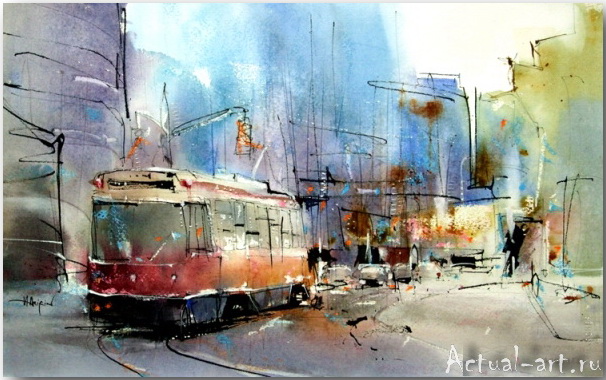
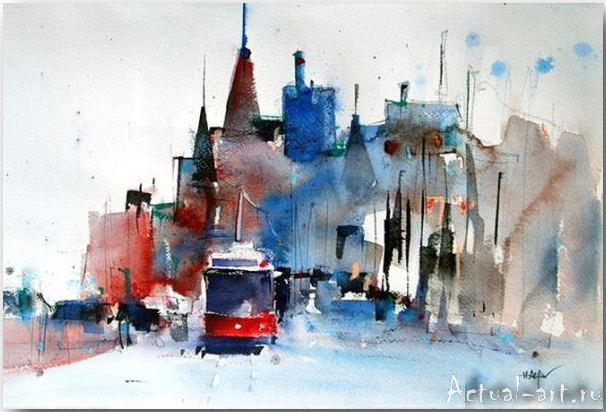
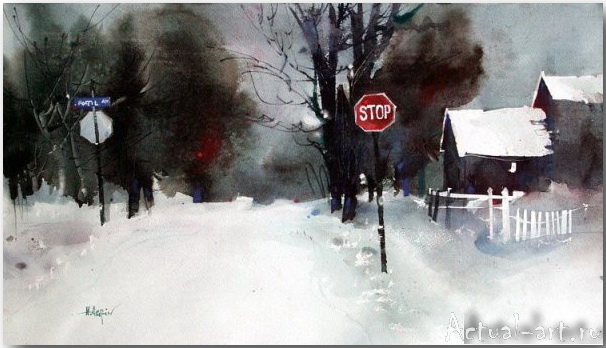
Herry Arifin: painting as a way of communication


Watercolor technique "A la Prima" is the work of painting on raw paper. Canadian artist Herry Arifin (Herry Arifin) began writing in this technique when he retired. It's more correct to say that he started drawing at all when he retired in 2002. Painting has become for him a means of communication, a means to express their feelings of peace. The pension cut off the habitual way of life from the new artist, which was filled with endless communications with other people. Fine art completely filled the vacant space.


Herry Arifin argues that many people often think that in order to draw, you need an innate talent, as well as a long period of study in an art school. But his personal experience shows the opposite: painting is a natural human activity. He never had any special training, except for a few lessons in the art studio, where he learned the basics of design and technical aspects of working with paints and paper. Right after that, the skill became a matter of practice and acquaintance with the works of high quality performed by other artists.

by Vladimir Kush
Actually, at the very beginning, Herrie Arifin tried to imitate them, but pretty soon I realized that he was developing only his own style. He chose watercolor because it matched both his personality and the style of painting. The favorite subject became trams - from childhood they seemed to the artist living creatures, eyes - the headlights of which always look with astonishment at the world. Now, with paintings of his paintings, too.